
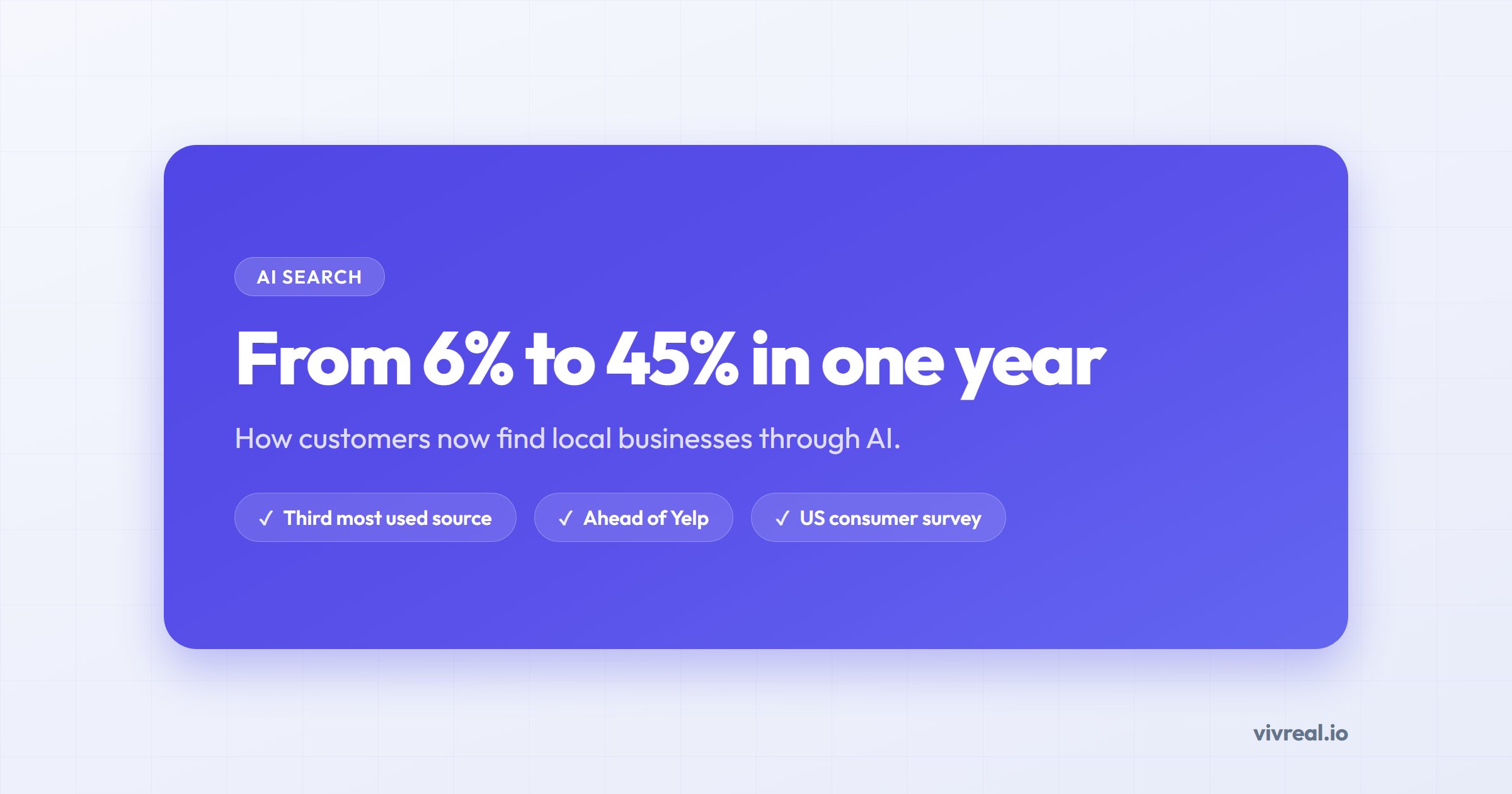
A year ago, about 6% of customers used an AI tool to find a local business. It is now 45%, which puts AI third behind only Google and Facebook as a way people look. What changed is not just the tool. It is the shape of the answer. Search gave your customer ten links and let them browse. An assistant gives them two names and a reason. Being on page one used to be enough. Now the goal is being one of the two.
Start free, no credit card. Setup in about two minutes.
Three things this changes
| The search era | The assistant era | |
|---|---|---|
| What the customer gets | A page of links to compare | Two or three names, already filtered |
| What decides it | Ranking, ads, and who they click | Whether your site states the facts, plus who vouches for you |
| Your margin for error | Being tenth still got some traffic | Being fourth gets you left out of the sentence |
The list got shorter. Ten results became two or three names. That sounds brutal, and it is, but it cuts both ways: a small business with clear, current information can be named ahead of a bigger competitor whose website is a brochure. Assistants are not weighing your advertising budget.
The customer arrives further along. They did not browse and compare, they asked and got told. So the people who reach you have already been pre-sold by a third party, which is why they tend to arrive ready to book rather than ready to shop. Measured across retail, AI-referred shoppers convert noticeably better than other traffic.
Trust moved. 63% of the people already using AI this way say they trust what it recommends about a local business, and 42% of all consumers now trust an AI recommendation as much as an online review. That is a meaningful amount of buying decision handed to a summary of your website that you did not write.
What an assistant is actually doing
It is not consulting a directory of businesses. When your customer asks, it goes and reads pages, and then it repeats the parts it can state confidently. Which means the outcome turns on unglamorous things: whether your hours are on the page as text, whether the service they asked about is named in the words they used, whether there is a price, whether anyone else online says you exist.
It also means this is refreshingly current. Ranking took months to move. An assistant reads your page when your customer asks about you, so fixing your hours today can change the answer this week.
What to do about it, in plain terms
Write the facts down, on the page. The job, the town, the hours, the prices, the phone number. As text, not inside a photo. This is most of the work and it costs you an afternoon.
Keep them current. An assistant confidently telling a customer you close at five when you now close at seven is worse than being missed. This is the part that quietly decides everything, and it is why "can I update my own site in a minute" is not a small question.
Get vouched for somewhere else. Claim your listings, collect reviews, be a real presence where your customers talk. Businesses mentioned in several places get recommended more often than businesses that only talk about themselves.
Make sure your site publishes a summary machines can read. This is the piece you cannot do by writing better copy, and most builders leave it empty. Every page of a Vivreal site publishes it automatically: fill in your address and your site describes itself as a local business, put a price on a product and it publishes with the price and whether it is in stock. Nothing to switch on.
The part nobody mentions
There are two kinds of AI robot reading websites now. One is the assistant fetching your page because a customer just asked about you. The other is a company collecting text and images to train a model. Vivreal sites let the first kind in and keep the second kind out, so you get recommended without handing over your photos and your words for training. Almost nobody in this corner of the market has made that distinction, and we think it is the right one.
The bottom line
The way customers find a local business changed more in one year than in the previous ten, and the winning move is unglamorous: state your facts plainly, keep them current, and be visible somewhere other than your own website. If you want the mechanics, start with why your business doesn't show up in ChatGPT, or run the ten-minute checklist.