
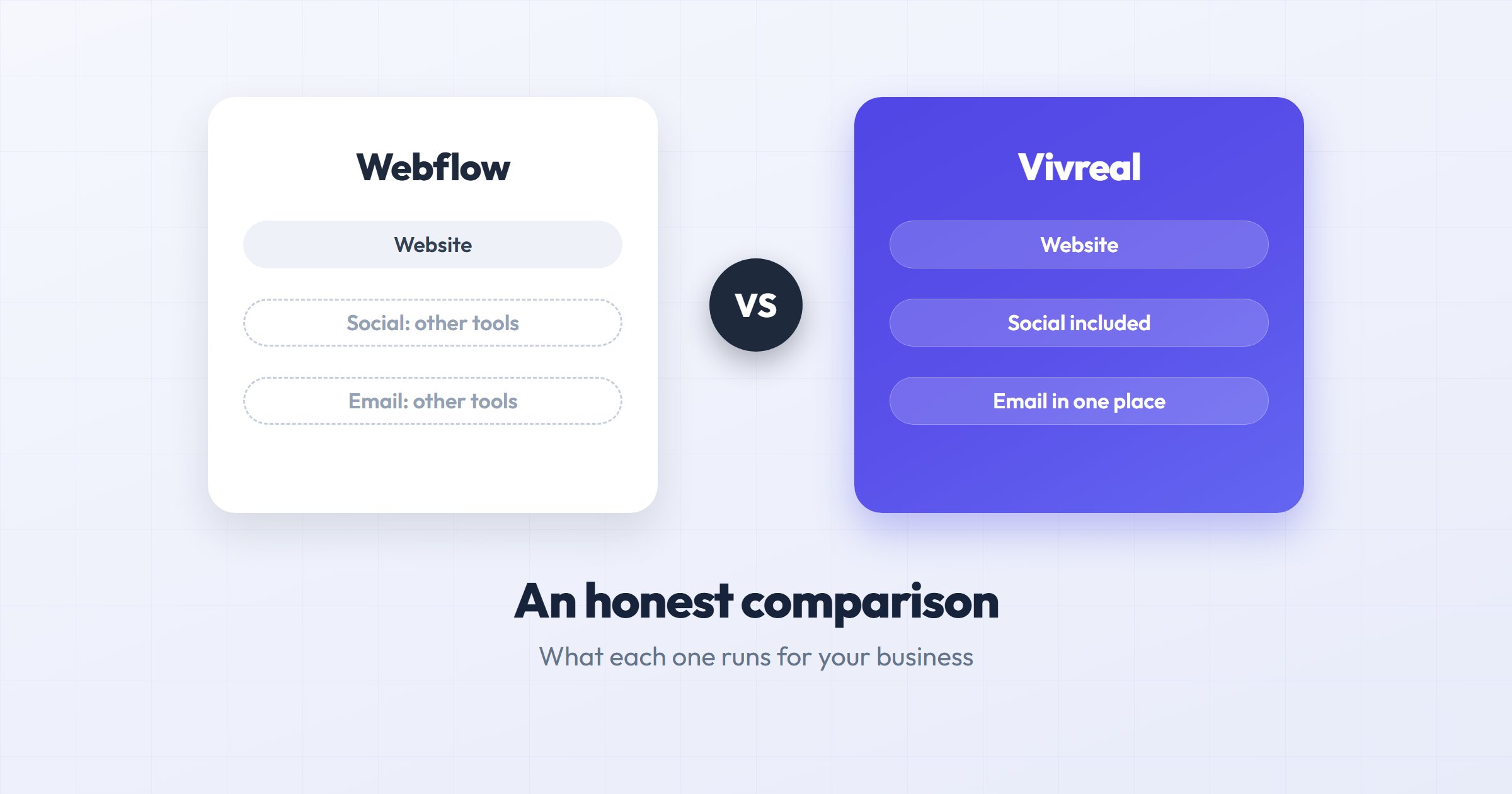
Webflow makes genuinely beautiful websites, and designers love it for good reason. The catch for a business owner is that Webflow is a design tool, not a business tool. Getting competent takes weeks of practice, polished work takes months, and most owners solve that by hiring someone, which means every small change is a message and a wait. Webflow also has no built-in email or social posting, so the marketing side is still separate tools. Vivreal gives you a professional site you run yourself in minutes, with social posts and email built into the same place.
Start free, no credit card. Setup in about two minutes.
Here's the honest side-by-side:
| Webflow | Vivreal | |
|---|---|---|
| Who it's built for | Designers and developers | Business owners |
| Getting good at it | Weeks to feel competent, months for polished work | Minutes |
| Changing your hours or a price | Usually a message to your designer | You do it yourself, in about a minute |
| What you pay for | A site plan ($15 to $25 a month billed annually) plus a workspace plan and seats on top | One plan, free to start, $19 to $119 |
| Social posts | Not built in | Built in, schedule ahead, one publish reaches every connected channel |
| Not built in | Connect Mailchimp and write, schedule, and send campaigns from Vivreal | |
| Found by AI assistants | Depends how it's built | Every page ships in a format AI assistants can read |
| Run it from your phone | Built on a desktop | The whole portal works from your phone or tablet, installs like an app |
What Webflow genuinely does well
Webflow is a serious piece of software. In the right hands it produces work you cannot tell from a custom-built site, with animation and layout control that most builders can't approach, and a content system underneath that's properly designed. Agencies build their businesses on it. If you have a designer you trust and a budget for them, Webflow is an excellent choice and you should keep it.
The question is what happens when you don't. Most owners we talk to don't have a designer on retainer. They have a business to run and a website that needs to say the right thing this week.
Gap one: the power has a price, and it's your time
Webflow's flexibility comes from exposing how websites actually work. That's why designers like it and why it takes most people weeks of practice to feel competent and months to produce something polished. That's not a knock, it's the honest trade of a professional tool.
For an owner, that trade usually resolves one of two ways. Either you spend the weeks, or you hire someone and every future change goes through them. Change your holiday hours, swap a photo, fix a typo on the pricing page: message, wait, review, sometimes a bill. The site stops being something you keep current and starts being something you manage a relationship with.
Vivreal is built the other way around. You start from a professional template that already looks right, and you edit it in a visual editor that builds the page with the same design your live site uses, so you can see how it looks as you go, on desktop and on your phone. Changing a price takes a minute, and you do it yourself. If you'd rather just describe what you want, a built-in helper that makes changes you describe in plain English is in an invite-only pilot right now, rolling out to more owners soon.
And you can do it from your phone. Vivreal installs on your phone or tablet like an app, so you can fix the hours from behind the counter instead of waiting until you're back at a desk.
Gap two: a beautiful site is only a third of the job
Webflow's job ends at the website. There's no built-in email marketing and no built-in social scheduling, so once the site is live you're back to a scheduler for your posts and an email tool for your list, each with its own login, its own bill, and its own copy of the words you already wrote.
Vivreal keeps all of it in one place. You write the update once. The page and the scheduled posts for each connected channel are built from it, and one Publish sends them together. Nothing drifts out of sync, because everything comes from the same source. For email you connect your Mailchimp account and write, schedule, and send campaigns from inside Vivreal, with opens and clicks reported back alongside everything else.
The pricing is simpler too. Webflow charges for the site plan and then again for the workspace and seats you need to work in it, which is why so many people are surprised by the second bill. Vivreal is one plan, free to start.
There's a quieter difference as well. More customers now ask an AI assistant for a recommendation instead of scrolling search results. Every Vivreal site ships in a format those assistants can read, so your business can be the answer, without you setting anything up.
What switching actually looks like
I paid a designer for my Webflow site. Is that wasted?
No. Bring the look with you. You start from a professional template, move your content across, and point your domain. What you're giving up is the wait and the ticket for every future change.
Can I keep my domain?
Yes. Your domain moves with you, same address, no interruption for your customers.
Is it as flexible?
Not in the way Webflow is, and we won't pretend otherwise. You get a professional template and a visual editor rather than a blank canvas with full control. In exchange, it stays looking right on every screen and you can run it yourself. That's the trade.
What happens to my other subscriptions?
Add up the site plan, the workspace and seats, the scheduler, and the email tool. For most owners that becomes one bill.
The bottom line
If you have a designer and you want maximum control over how the site looks, Webflow is a great tool and you should keep it. If you want a professional site you can actually run yourself, with your posts and your email in the same place, from your phone, that's exactly what Vivreal is for.